Self Active Play Pilot: Nine students/Clinical/Geriatrics/LTC/Palliative. Contemplative Play. Using open-ended materials. Two angles: 1) PRN medication as instrument (may address pain, anxiety, insomnia, depression, i.e.). Methodology: resident participants are their own controls – indicated by reduction in usage from baseline before palliative QOL intervention and end of 12 weeks – or possibly each session at baseline to measurable outcome following session. Use horizontal graph to show hypothesized plateau with prior trend, or decrease in usage; 2) QOL statements. Could be data collected for theme building, as well as photographs (Action Research methodology).
Day 1: We had our first day, on Saturday, for 30 minute “relationship building”, aka., self-active play with residents. Afterward, spoke with the students about neuroplasticity and Resilience and wellbeing. We took a few minutes in post-conference to go around in circle quickly to state 1 word or phrase from the afternoon experience. A common theme was students expressed a deeper connection with their residents: “Saw another side of my patient.” “At the start my resident said she couldn’t do it. At the end she was smiling saying she was going to give what she made to her best-friend. I didn’t know she grew up on an Indian Reservation.” “My resident who isolates, was talking, sitting in a circle and asked, When are we going to do this again?” It seems the short term experiment was a powerful wellbeing exercise. In the future we’ll take 30 minutes/Saturdays-with a focused exercise of what it means to promote deeper understanding and life-affirming recognition for residents. Students are wakened to, “health as expanded consciousness” (M.Newman), and participate as researchers in a quality of life intervention to address physical, emotional, cognitive, social and spiritual (aka. palliative) gerontological health. Day 1 was a hit. A lot of fun, and inspiring.
Preface to Day 2:
Within the activity, is also student opportunity for observing themselves as researchers and participants. An understanding of “spiritually-emotional intelligence”, or capacity for presence, is experientially understood. The opportunity to be researchers who also collect data and form themes from their facilitated intervention, may encourage enhanced perspective, or capacity for empathy and engagement, aka. S-EI. The idea being, that once students experience the potential for “relationship building”, they can see its value – in (Discuss in post-conference) critical thinking, narration, and story-telling. Out of an i.e.., joyful, nostalgic, or self-identifying encounter for the resident, the students, as observers and participants, gain an awareness of what is both opened and constrained; or, medically speaking, what may surface may be helpful in goals for care. Once experienced by students, when they are professionals in the rut of routine tasks that dictate only 3 minutes to visit, or assess, or assist, those 3 minutes have a reference point, or place of association that knows the meaning of empathic and caring presence. There was reticence in one student bystander, I imagine her to be surprisingly adventurous Day 2.
Post-conferences, have covered: Day 1 orientation): Broken Heart Syndrome, or Takotsubo: its implication in health as a concept. Students have since been fascinated, and they really get it., Week 2): Neuroplasticity and resilience; introduction as river and riverbed. (These are visual learners for the most part). Week 3): They identify story-telling, CSAP, narration in wellbeing-intervention with critical thinking connections…open discussion to how case examples may be formed as relevant to symptoms of psychological or physical discomfort. (These students are strongly motivated to fully grasp measurable outcomes – they are a dynamite team to define MO’s).
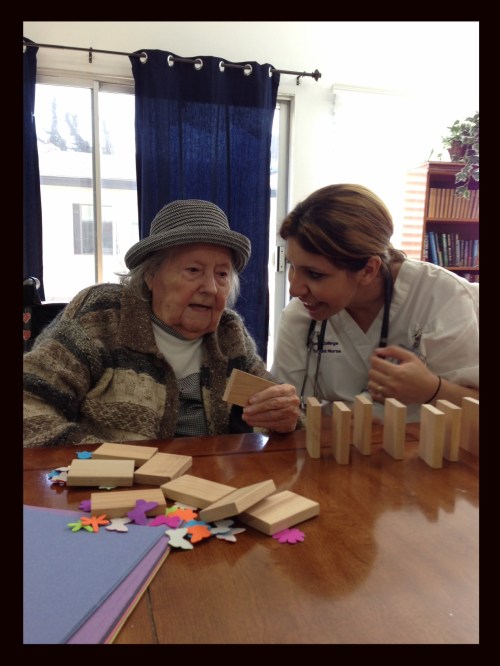
– Day 2.2.23.13
Day 2: The context of this photograph is Nina is transcending from words in dementia to a song in a low deep gentle voice that transfixed the room. Nelli is a student who two years ago moved from Armenia. She is listening to Nina begin the anthem rooted in the old country, or Croatia. The surrounding students and residents in interactive play all became quiet, and moved into an inner-reflective, or contemplative self-active play (CSAP) that soaked in this wonderful woman’s spirit. I too participated. And felt my soul being touched.
Neuroplasticity, Resilience and Contemplative Self-Active Play (CSAP) in Aging: Pilot by 9 Students and a Teacher in Long-Term Care Community College Nursing Program.
METHODOLOGY
Students ask all of their randomly assigned residents if they would like to participate in a 30 minute creative activity in the afternoon, an hour after lunch, in one of the facility’s activity rooms. Some students have 2-3 accompanying residents, some 1, and other students, generally 1 or 2, have treatments or extenuating circumstances that necessitate them being on the floor. Their resident engages with one of the groups or solo play, whichever she/he prefers.
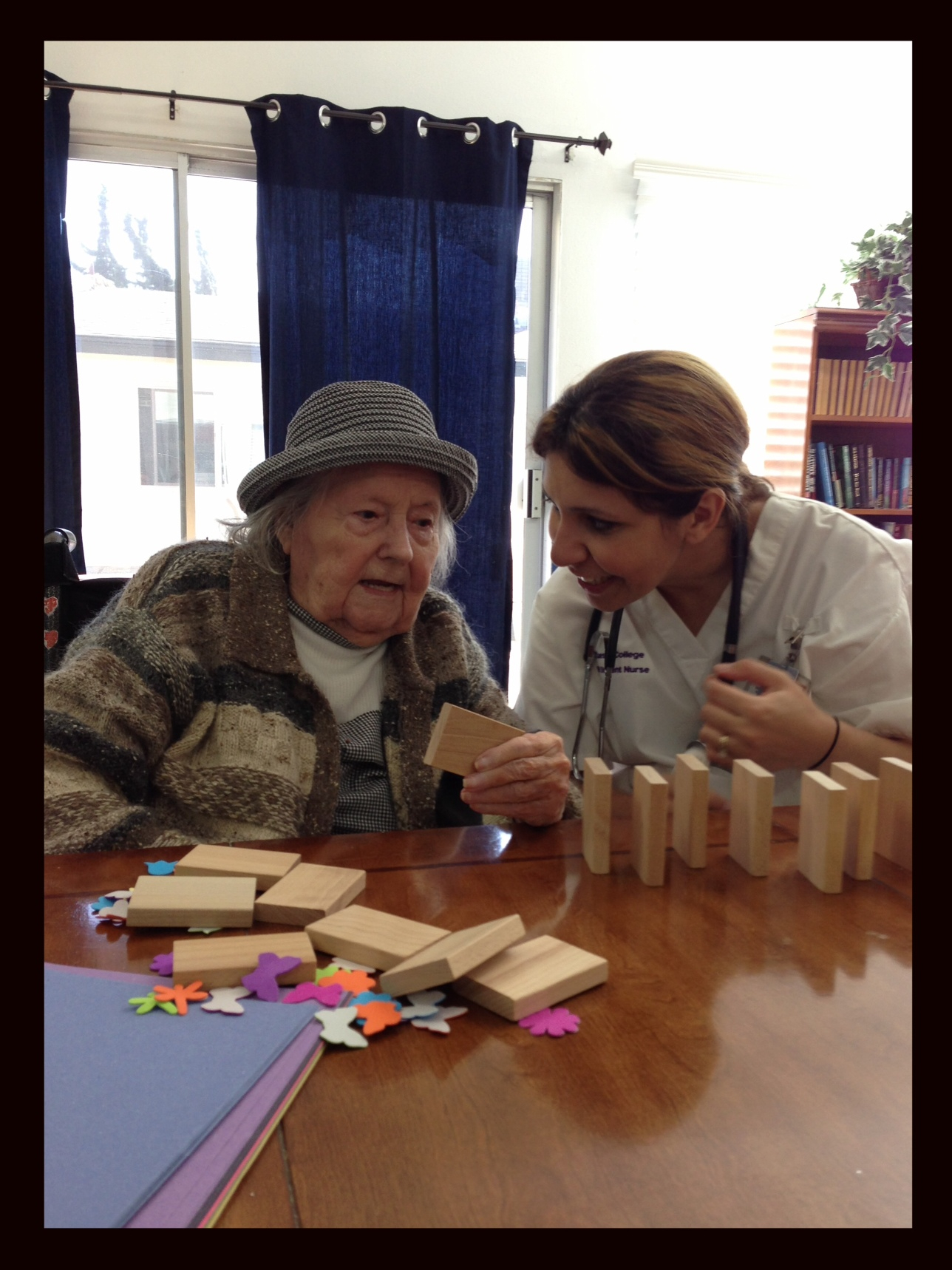
Although we may use many colored open-ended materials, including paint and brushes, each resident has a box of blocks (30 pine wood blocks/box 5 x 5). Data is photographic action research, and includes statements made by students (both researchers and observers of their own experience in CSAP) and residents. The benefit for the students is enhanced experience of “relationship building” and increased cultural awareness of diversity and the marvelous complexity of aging. The benefit for the residents is creative expression. And an hypothesized avenue to participatory meditation, self-reflection, engaged presence and wellbeing.
The research community worldwide has begun to acquire a plethora of experimental research with implications for increased resiliency, or mindful neuroplasticity, using meditation as a component of contemplative care (CITE). For many persons with depression, or anxiety, or agitation, or boredom, or loneliness, or propensity for isolation, or pain, or insomnia, or restlessness, the entrance to meditation as an activity that promotes resilience, is an impossible challenge to stay still.
Contemplative self active play, in solo and interactive milleu, is observed as a seque for inner exploration within the context of one’s environment. Allowing oneself to just play, without repercussion, judgement, fear or agenda was experientially understood by the students. Students also noted that statements and themes of wellbeing, gathered in data and made by resident participants, opened their eyes to the real people they were caring for.
When the last week of participatory research is complete, students do a secondary data assessment, by looking back into the medpass to see if any difference in prn medication afternoon or evening until following 12pm – 12am – 12 hour chart check (quantitative aspect).
Common themes : statements made by students and residents during and after.
Photographs both alone and with narrative.
Statements made by students:


 Contemplative Play