Research notes
In the article, “Roadmap for a participatory research-practice partnership to implement evidence” (Harrison & Graham, 2012), context driven research versus academic driven, is implemented through a, “planned action approach”. Clinically initiated research provides opportunity for immediate and current practice-partnership, that thereby promotes evidence-based nursing. The authors outline 3 phases of study, I) Issue identification, II) Solution building, and, III) Implementation, evaluation, and nurturing the change. “Working closely with practice and health services partners is key to this approach.” (p.212). As a geriatric clinical nursing instructor and palliative NP, I am interested in clinical research in order to build mainstay practices for improved geriatric care.
Bayside Long Term Care is owned by Compass who has many long term care residences on the Central Coast. The Director of Nursing and Chief Administrator expressed a strong interest in ‘participating’ in the research we proposed. Consent form for resident volunteers, or designated health care proxy, asking permission to be photographed, and 1 paragraph “Intention for Research” to be given to Bayside’s attorney to approve will open the door fully for students to participate in contributing to outcomes in wellbeing for older adults and elders in longterm care. At least we hypothesize! We have methodology all but mapped out (Only 4 weeks left of this semester in clinical). The last and secondary data collection will be review of medpass charts on days of CSAP /30 minutes, after the last day of Contemplative Self Active Play (CSAP), for indication in any change of “As needed medication” from 12pm – 12am. Photographic and statement data with gathering of themes is ongoing.
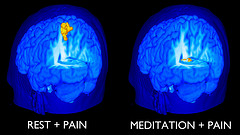 – Davidson, 2010
By addressing the potential toward wellbeing in older adulthood (more than staving physical loss), we are interested in a developing community awareness, that the ability of an older adult to find inner resources for dignity and quality of life are equally as important as being recipients of palliative care precepts. As palliative care researchers, we have benefitted from witnessing contemplative play as a cross-generational approach, form of meditation, and pathway for self-actualization and self-advocacy in aging, chronic illness and end-of-life.
The authors would like to address the benefit of creative expression, and speak to the evidence shown of older adults exploring inner wisdom and vital meaning through relaxed and creative contemplative play. Margaret Newman, one of nursing’s foremost theorists, speaks of health as expanding consciousness. The transformative process of self-understanding that may be facilitated through creative purpose has implications for improved health and wellbeing when considered within the same fascia of physiology: In a state of relaxation where play is a non-intrusive activity, stress hormones are reduced, vital signs tend toward homeostasis, dementia is given a harbor for self-presence, which has shown to soothe states of depression and anxiety. For the cognitively or physically compromised older adult, disenfranchisement is translated into possibility.
Exploring inner wisdom and self-reflected life “meaning” through contemplative play: Photographs and journal writings have revealed joyful glimpses of elders reflecting on who they are in the context of their health care settings and community. Participants’ descriptions have revealed improvements in symptom management and wellbeing.
Objective: Aging in our culture has largely carried with it the stigma of loss and degeneration. By addressing the potential toward wellbeing in older adulthood, we hope to facilitate an interactive workshop using creative materials and guided contemplative play; we hope to further promote discussion in palliative care, that creativity may contribute to dialogue on the relationship between the current medical directive model of care and emerging palliative paradigm.
 Contemplative Play